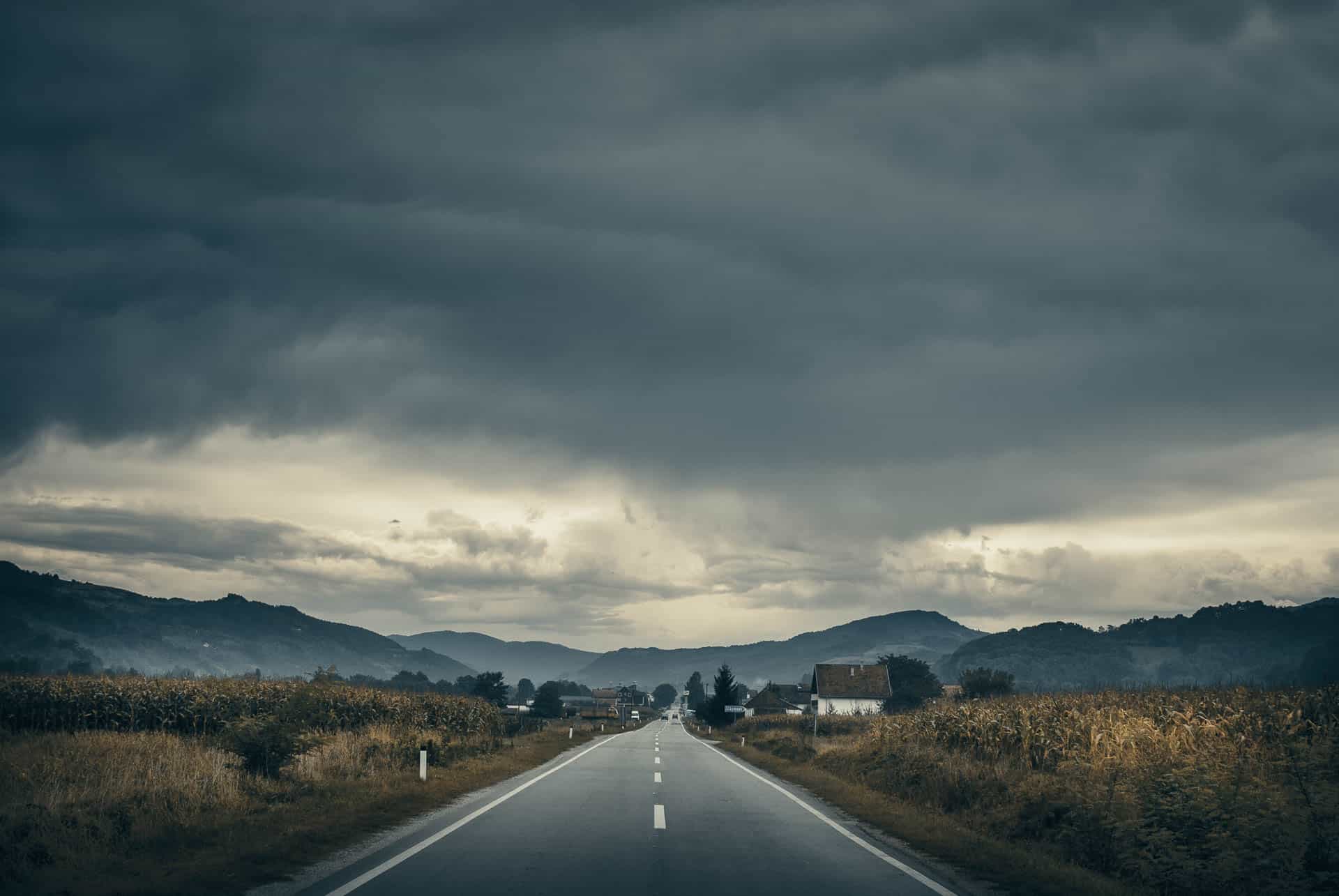
I was cycling through Central Serbia, heading straight toward those distant, misty(ish) mountains you see in the background. The weather had been building for a while – heavy clouds rolling in, constantly shifting, darkening by the minute. For a long stretch of that ride, I could see this photo before I took it. The road itself, the cornfields, the changing sky – all the elements were there. It was just a question of when to stop.
I waited until that little village revealed itself a bit more. Once the houses were big enough in the frame to feel like part of the composition – not just distant, meaningless dots – that’s when I stopped to take the photo.
I composed this photograph using a symmetrical composition. The road splits the frame, leading the eye directly to the centre, which automatically creates a sense of balance. That symmetry gave the stormy sky and dramatic cloud formations room to breathe – especially that lighter of lighter sky above the mountains, which brings just enough contrast to stop the image from becoming too dark and heavy.
You’ve got these soft, blue-grey mountains in the background – slightly misty from the distance – and then more defined, crisp textures in the foreground: the houses, the trees, and the maize fields running along either side. The road does all the work in guiding your eye into the frame.
And I loved the mood and atmosphere, both when I was there and now, looking at this photo. It’s stormy, tense, and quiet. The kind of light that in theory is boring, but in reality is just as compelling as dawn and dusk light (in its own way of course).
I get asked a lot about “the subject” in photos like this. Like what is the subject? Some people find it confusing when there’s no obvious object. But for me, the subject here is that central vanishing point – the space where the road disappears into the mountains. That’s where I want your eye to go to when first viewing the image. It’s not a physical object, but it’s where I, the photographer, want the viewer’s eye to go to, from where the viewer can explore the rest of the image. At least that’s the intention.
And if you’re wondering — yes, it did rain.
What Happened Next
After taking the shot, I got back on the bike and kept cycling, climbing into th emountains. Not long after entering the mountains, the sky opened up and it absolutely chucked it down. I got soaked. No shelter, just me, the rain, and a slow climb into the hills.
Eventually, right near the top of the mountains, I came across a small mountain community – possibly loggers, judging by the setup – and one of the locals saw how wet and frozen I looked. They invited me into their home. They fed me, dried my shoes in the drawer of a pot bellied stove stove, and pointed me to a tiny hotel nearby where I stayed that night.
So yes – it was a brutal ride. But I got this photo. And I got that experience. So now looking back, it was a good thing…I think!
How I Processed It
In Lightroom, I desaturated the colours slightly — just enough to give the image a muted, weathered feel. The tone curve helped bring out that faded look I wanted, and I worked the shadows in the clouds to pull out more detail without making them look overcooked. I added a vignette to push the eye toward the centre – where that road pulls everything inward.
The maize fields kept some warmth, which plays nicely against the cooler tones in the sky and mountains. The whole palette was muted to try and represent more what I felt when I was there.
So here’s a question: when you look at this photo, where does your eye go first? What do you think the subject is?
If you’ve ever struggled to figure out the “main object or thing or area” in your own compositions – or you’ve got a similar story of shooting in wild weather – leave a comment below.